In clinical medicine, a case series is used to document experiences that one patient alone cannot establish, but that become increasingly difficult to ignore when similar cases appear repeatedly. This series takes that idea into the context of education, poverty, and student wellbeing across Africa. Each case represents a broader question about what happens when students have the ability and ambition to succeed but lack the basic resources needed to remain in school.
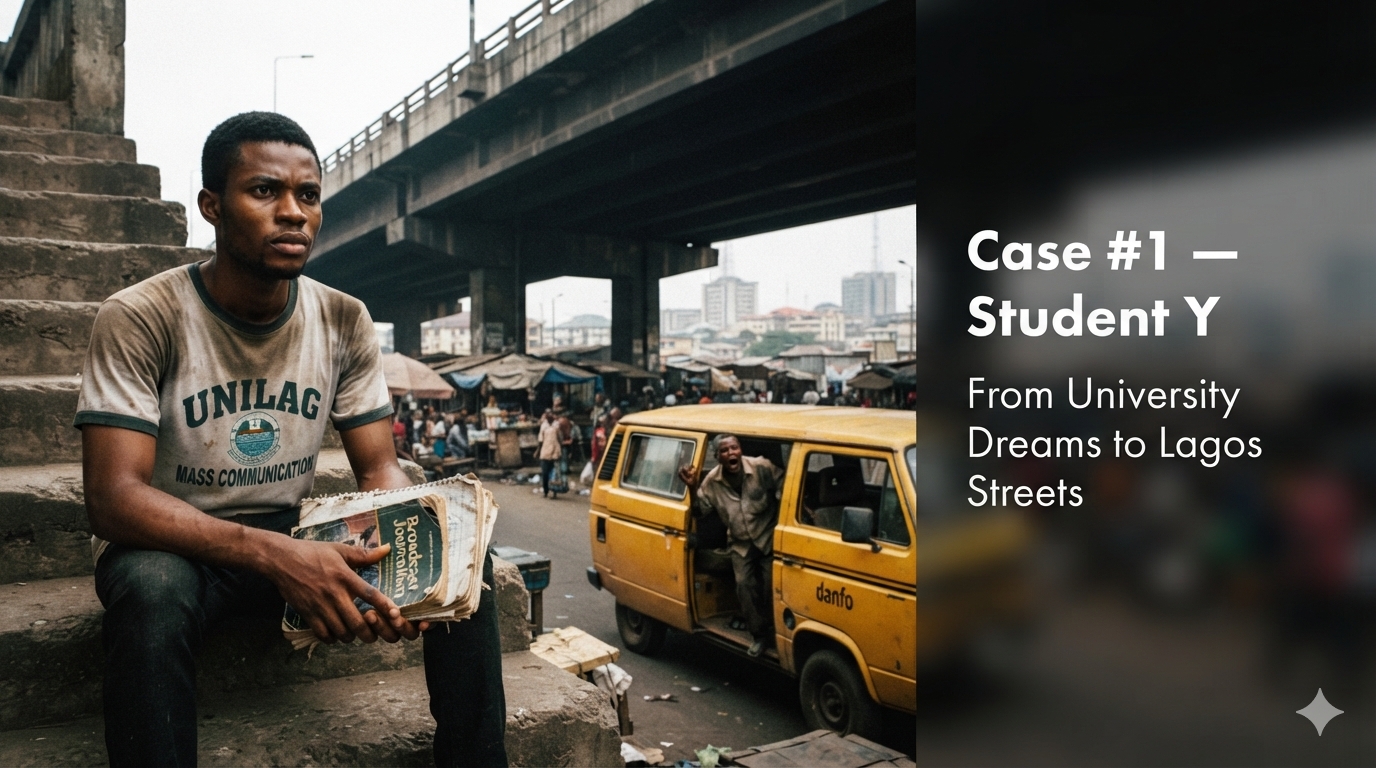
Student Y was studying Mass Communication with dreams of telling stories that matter. According to the account shared by the original source, poverty eventually brought that educational journey to a halt. Today, he reportedly lives under a bridge in Lagos and works as a bus conductor, helping other people reach their destinations while his own educational journey has stalled.
The original account states that less than ₦100,000, approximately $70 at the time the account was shared, stood between Student Y and completing his degree. Whether that amount represented the full cost of what he needed or the specific financial barrier he was facing at the time, the story raises a much larger question: how many students are forced out of higher education because a relatively small financial barrier becomes impossible to overcome?
Student Y is not simply a dropout statistic. He is an example of what can happen when poverty intersects with education and there is no adequate support system available to help a student through a difficult period. His story is a reminder that academic ability and ambition do not always determine whether a student gets to graduate.
Across Nigeria and other parts of Africa, many students face financial pressures that extend beyond tuition. Food, accommodation, transportation, learning materials, healthcare, and other basic needs can all affect a student's ability to remain in school. For a student already living with limited financial resources, an unexpected expense or a relatively small outstanding payment can become the difference between continuing an education and leaving it behind.
This is why conversations about student success cannot focus only on academic performance. A student may have the intelligence, motivation, and ambition required to succeed but still struggle to complete their education because their basic needs are not being met.
When a student leaves university because they cannot afford to continue, the consequences can extend beyond that individual. Families lose opportunities for upward mobility, communities lose potential professionals, and society loses skills and knowledge that could have contributed to its development.
Government has an important responsibility in creating an environment where students can access and complete higher education. However, government cannot solve every student need alone. Communities, universities, nonprofit organizations, private institutions, philanthropists, professionals, and individuals can all contribute to building stronger systems of support.
That is part of the reason Impact Project exists.
Impact Project is working toward building a community and developing practical solutions that can help college students across Africa remain connected to their education, starting with Nigeria. Our work focuses on challenges that can push students away from school, including food insecurity, poverty, health needs, and limited access to meaningful support.
The goal is not simply to talk about student poverty. It is to understand the problem, create awareness, connect students with resources, and develop solutions that can be strengthened and replicated over time.
We cannot change the circumstances of every student overnight, and we cannot assume that one organization can solve the wider problem of student poverty. But we can choose to pay attention to the stories that are often overlooked. We can learn from them, build stronger support systems, and create opportunities for students to remain in school when financial hardship threatens their education.
Student Y's story should not end under a bridge. His story should challenge us to think about what could have been different if the right support had reached him at the right time.
With good intentions, the right people, meaningful collaboration, and faith, a breakthrough is possible. Impact Project is committed to being part of that effort and to working with people and organizations that believe students deserve a better chance to complete their education.
If you are a university, organization, professional, philanthropist, community leader, or individual interested in supporting student wellbeing and educational continuity, we would like to hear from you. There is a role for collaboration, research, advocacy, resource development, and practical student support.
Student Y's story is one case, but the question it raises is much bigger: How many students across Africa are capable of completing their education but simply need someone in their corner?
We want to help find better answers to that question.
Learn more about Impact Project and our work to support students across Africa.
This article does not claim that Impact Project personally knows, represents, or has independently verified Student Y. Student Y's story was obtained from an external source and is being shared for awareness and discussion. Impact Project does not claim ownership of the story or any personal information concerning the individual.
Original source